


Ancient Education And Today
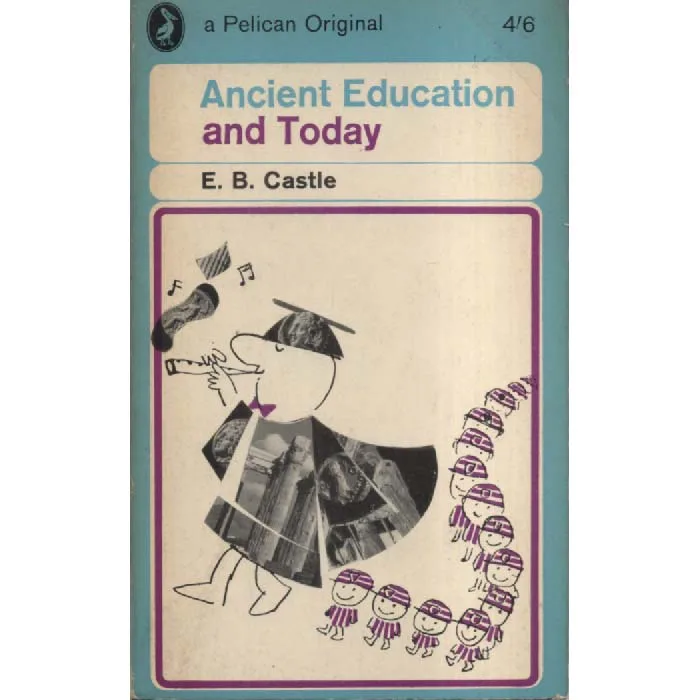
Publisher: Pelican Books
Format: Paperback
ISBN: none
Education is one of humanity’s favourite subjects. Every generation is convinced the previous generation did it wrong, the next generation is doomed, and somewhere in the middle a committee is commissioned to investigate why children no longer know what anyone thinks they ought to know. Ancient Education and Today is a fascinating reminder that these arguments are far older than most people realise.
Written by E.B. Castle and published in this 1967 Pelican edition, the book explores the educational systems of the ancient world and compares them with modern ideas about learning, teaching and civilisation. It turns out that long before league tables, online learning platforms and endless debates about curriculum reform, the Greeks and Romans were already worrying about what young people should be taught and whether society was heading in entirely the wrong direction.
One of the great pleasures of this book is the comforting discovery that educational arguments are apparently immortal. Ancient philosophers complained about the youth of their day. Teachers worried about standards. Parents fretted about preparation for adult life. Students looked for ways to avoid difficult work. In other words, very little appears to have changed over the past two thousand years except the availability of Wi-Fi.
Castle examines the educational traditions of classical societies, exploring how they shaped citizens, leaders, thinkers and soldiers. Education in the ancient world was not simply about passing examinations. It was often intended to produce a particular type of person, someone capable of fulfilling a role within society. Whether that role involved governing an empire, debating philosophy or commanding a legion varied considerably, but the ambition was remarkably consistent.
There is a delicious irony in reading a book about ancient education from the perspective of the modern age. The ancient Greeks developed systems designed to produce wise and virtuous citizens. Modern education often seems designed to ensure nobody forgets their password for the online portal. Somewhere between Socrates and spreadsheet training, civilisation appears to have become rather more complicated.
What prevents the book from becoming dry is its broader perspective. This is not merely a catalogue of old schools and forgotten lessons. It is an exploration of enduring questions. What is education actually for? Should it train people for work, cultivate character, encourage independent thought or preserve cultural values? The fact that these questions remain unresolved is perhaps the strongest evidence of their importance.
As with many Pelican Books, there is a wonderful confidence in the writing. This was an era when publishers believed ordinary readers were perfectly capable of engaging with serious ideas, and authors responded by producing thoughtful works that informed without patronising. The result is a book that feels scholarly but approachable, intelligent without becoming intimidating.
This 1967 edition now occupies an amusing position in history. A book comparing ancient education with the modern world has itself become part of educational history. Readers today can observe not only the ancient systems being discussed but also the assumptions and concerns of the 1960s. It is effectively a historical study wrapped inside another historical study, rather like finding a Roman coin inside a Victorian biscuit tin.
This copy is in good condition and is sold by Crappy Old Books. It remains a rewarding read for anyone interested in history, education, philosophy or the recurring suspicion that every generation is convinced it has invented problems that humanity has actually been discussing since antiquity.
An engaging journey through centuries of educational thought. Proof that while classrooms, technologies and teaching methods may change, the eternal question of what children ought to learn remains gloriously unresolved.
Keep browsing: See more Non-Fiction books Other books by EB Castle
